Intended for healthcare professionals
Medscape caves in on courses funded by tobacco giant Philip Morris, while medics fear global push into medical education


The Safety of Rwanda Act: a pointless exercise in performative cruelty
Why do politicians have such a low opinion of British people’s compassion to think this policy is a vote winner, asks Martin McKee
The Safety of Rwanda Act: a pointless exercise in performative cruelty
Why do politicians have such a low opinion of British people’s compassion to think this policy is a vote winner, asks Martin McKee

Prenatal opioid exposure and risk of neuropsychiatric disorders in children
Opioid use during pregnancy is not associated with a substantial increase in the risk of neuropsychiatric disorders in children, finds study
Prenatal opioid exposure and risk of neuropsychiatric disorders in children
Opioid use during pregnancy is not associated with a substantial increase in the risk of neuropsychiatric disorders in children, finds study

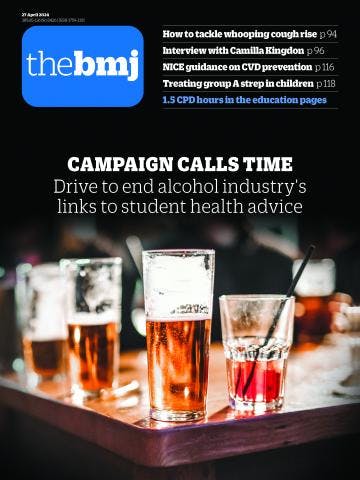
Big alcohol: Universities and schools urged to throw out industry-funded public health advice
The harms of alcohol are being minimised in industry funded education, finds this Investigation
Big alcohol: Universities and schools urged to throw out industry-funded public health advice
The harms of alcohol are being minimised in industry funded education, finds this Investigation
ICBs failing to fairly allocate funding to hospices across the country, MPs told
Diabetes UK defends partnership with Slimming World in face of criticism
Action demanded on alcohol as deaths hit record levels
Experts call for school focused support to overhaul children’s mental health services
Achieving more equitable access to assisted reproduction
Pelvic organ prolapse: self-management of pessaries can be a good option
Helen Salisbury: Sick notes and a national illness service
Latest articles
News

US Supreme Court hears arguments on whether states can regulate emergency abortions
People in mental health crisis are still being criminalised owing to NHS failures, says report
NHS England sets out measures to improve rotational training
Gaza: Hundreds of bodies are recovered from mass graves at two major hospitals
New foundation doctors express anger at being allocated “placeholder job”
Sixty seconds on . . . bird flu
Texas anaesthesiologist poisoned IV bags that made patients ill and killed fellow doctor, court finds
Gaza-Israel conflict: World Medical Association backs BMA’s call for sustainable ceasefire
Research

Effect of combination treatment with GLP-1 receptor agonists and SGLT-2 inhibitors on incidence of cardiovascular and serious renal events
Temporal trends in lifetime risks of atrial fibrillation and its complications
Antipsychotic use in people with dementia
TRIPOD+AI statement: updated guidance for reporting clinical prediction models that use regression or machine learning methods
Predicting the risks of kidney failure and death in adults with moderate to severe chronic kidney disease
Impact of large scale, multicomponent intervention to reduce proton pump inhibitor overuse
Esketamine after childbirth for mothers with prenatal depression
Comment

Clarity in the law is needed to stop physical punishment of children
Doctors can’t fix the alcohol problem by themselves
The future health risks of adverse pregnancy outcomes … and other research
John Launer: Doctors as activists
Medicine is designed for righthanded people
A new approach to oral health can lead to healthier societies
When will Canada have national pharmacare?
Healthcare professionals deserve support services tailored to their needs
Doctors should not be simply the ghost in the machine
Education

The ever looming shadow of caregiving
Assessment of diplopia in adults
How to communicate about climate change with patients
Alternative routes into clinical research: a guide for early career doctors
Advances in management of heart failure
Non-acute heart failure management in primary care
Effectiveness and safety of drugs for obesity
Dry eye disease management
Caring is the invisible piece of the stroke recovery puzzle
Stroke rehabilitation in adults: summary of updated NICE guidance
Workforce


BMJ Medicine


Identification of patients undergoing chronic kidney replacement therapy in primary and secondary care data
Apr 18
New insights into understanding obesity
Mar 29
Characterization of approval status, endpoints, results, and recommendations for oncology drug treatments from the NCCN
Apr 5
Practical implications of the ADNEX risk prediction model for diagnosis of ovarian cancer
Apr 3
UK Jobs
Current issue
Most read
1.
Effect of exercise for depression: systematic review and network meta-analysis of randomised controlled trials
2.
Use of progestogens and the risk of intracranial meningioma: national case-control study
3.
Ultra-processed food exposure and adverse health outcomes: umbrella review of epidemiological meta-analyses
4.
Multiple adverse outcomes associated with antipsychotic use in people with dementia: population based matched cohort study
5.
Advances in management of heart failure
6.
Delirium and incident dementia in hospital patients in New South Wales, Australia: retrospective cohort study
Community
Latest responses
Advanced age is a risk factor for the onset of Meningiomas: increased exposure to ionizing radiation over the years?
Re: Sunak is accused of “harmful” rhetoric amid plans to remove sick note responsibility from GPs
Re: NHS England looks to cut back on doctors’ statutory and mandatory training; look at the burden caused by CPD & appraisals too
Investment in a healthy childhood will have enormous returns.
Ensuring Data Integrity in our Meta-Analysis on Antenatal Steroid Administration for late preterm birth
What are your thoughts?
Altmetrics

Covid-19: Researcher blows the whistle on data integrity issues in Pfizer’s vaccine trial
Nov 2, 2021


The illusion of evidence based medicine
Mar 16, 2022